I always run with headphones on. I’ve got a weird Eustachian tube defect that makes my ears hurt when I run or if there’s the even slightest bit of wind. So yeah, when I run I am always listening to something. I’ve got playlists sorted by pace, an app that has me running to escape post-apocalyptic zombies, podcasts, and of course, audiobooks. This week I’m listening to The Life-Changing Magic of Tidying Up by Marie Kondo. The subject matter is soothing (a big plus when you are trying to keep your heart rate down), and I really do want to try this process and actually sort through all of my belongings, once and for all. Also, if you are trying out this low heart rate training the Phil Maffetone way, you know that one of the things he encourages you to do is to try to eliminate stress from your life. Decluttering fits right in with that. During my run yesterday I actually found myself fantasizing about what life would be like without all of the paper I’ve accumulated over the years, and how good it would feel to know where everything is. The book is short–you can read it in a day, and the audiobook is less than 5 hours long. If you’ve got a library card you can borrow the audiobook online (with the Chicago Public Library the app is Hoopla, and you can sign up for your library card online). So now I’ve got two goals for October: to run the Chicago Marathon, and to complete my KonMari sort, choosing to keep only the items that spark joy in my life. -Ceds
Author: hydeparkhustle
The Teardown
I was never a runner. An athlete, yes, I was always an athlete–through my childhood, high school, and on through college, I was an athlete. But the lap running that every sport seems to include was always my least favorite part of practice. After college and all through grad school I mostly sat on my butt, making occasional forays into yoga and weightlifting, but generally deciding that I was too busy for fitness. This all changed a few years ago. My brother Marcus, who has been running since high school, finally talked me into signing up for a 5K with him. Another 5K followed, and then an 8K, and then finally a half marathon. Since our running fitness levels were vastly different, I got my running advice online. I decided, somewhat arbitrarily, that I was an 8 minute miler (based solely on my not too distant history of athleticism). I googled a few training plans and followed them somewhat haphazardly. My goal was generally to try to hit the requisite weekly mileage, and I ran each workout at whatever pace I felt capable of that day. I was racing at about a 8:30 min/mile pace, but each race was a struggle, and I was plagued by minor injuries—mystery knee pain, mystery foot pain, blisters—nothing dramatic or far from what I considered the norm for runners.
So that’s where I was, running several races every year, sometimes lifting, sometimes stretching, and sometimes injured, up until October of last year. That is when I sat down with a friend and we talked each other into signing up for the 2018 Chicago Marathon. And ever since I got that Chicago Marathon confirmation email I’ve been worried. I sat on my butt and worried all winter, googling marathon training plans and top ten lists (there are a surprising number of first-time marathon runner top ten lists: errors all first time marathon runners make, what I wish I’d known before my first marathon, etc.). Most of the programs I found started out by asking you about your current fitness level, and your last race finish time, so I started pulling up all my past results.

My best half marathon time is 1:50:47–that’s an average 8:27 min/mile pace, which is just what I expected/hoped. The problem is, that result is from 2015. Looking back on my results what I saw was a lot of 9+min/mile averages for my long races. Instead of improving as a runner, at best you could say I’d plateaued, but really my best times were a couple years ago, so I’ve been getting worse. I looked at my old Instagram race day posts, and they are littered with captions like “remind me to train properly next year!” and #Whydidntitrain. So of course I then pulled up my old Nike app and looked back on all my training runs. It became painfully obvious: my fast runs were too slow, my slow runs were too fast, and my overall mileage was crap. If I train for the marathon like I’ve trained for all my other runs I will probably find myself limping across the finish line in October. If I finish at all. I will definitely bonk. I can picture it quite easily: I start the race with a minor injury that I’ve been nursing for several weeks, I go out too fast, at mile 14 I’m on target for my goal finishing tine, but by mile 18 I am a mess. I hobble the rest of the race. This is not what I want.
The Blueprint
The internet is full of advice on how to train for a marathon, which is both good and bad. As I started panicking about the 2018 Chicago marathon I dove, head first, into research mode. The training problems that I’ve had are common ones, so I found a lot of opinions on how to best fix them. Ultimately I stumbled onto a running blog called the extramilest. This guy, Floris Gierman, shaved more than an hour off his marathon time by adopting a training plan that focuses on low heart rate running. With this method you calculate your MAF (maximum aerobic function) heart rate, which gives you the heart rate range that you train at. That’s it. You do all your running in that heart rate range and gradually build up your aerobic base. You run slow for a very long time. On the surface that sounds terrible, but what drew me to it immediately was first, that it wasn’t just an extended version of one of the many half marathon training plans that I’d already failed at, and second, that it promised a way to run the long miles without dreading them. When I read that I realized just how much I’d been dreading adding all that extra mileage.
MAF training is its own internet rabbit hole, and once you start googling it you invariably reach Phil Maffetone, the MAF method “guru.” Whenever I start agreeing too much with something I worry that I’m being sold something, and Phil Maffetone’s website definitely gives me that feeling (and he is, in fact, selling quite a few things). But, you can’t argue with the building blocks–every marathon training plan I’ve looked at includes long slow runs for base building. Where the MAF method differs is how long you train without any speedwork. You do add it back in, but not until you’ve trained for months with only your heart rate monitor to guide you. I read through a lot of criticism of the method too, but the harshest critics always seem to be people who have already developed their aerobic bases. Maybe after I’ve trained this way for a year I’ll start to feel like it’s not enough for me either.
So that’s where I am. I’ve calculated my MAF heart rate (180 – your age, – 10 more since I have allergies and asthma) and I will be doing all of my runs for the next 3 months at a heart rate between 127-137 bpm. I’ve proven that I can’t be trusted to slow down on my own. “Conversational pace” means very little to me. This way the guesswork is removed. My watch beeps at me and I slow down. That is the plan. Wish me luck, and I will keep you posted on my progress. -Ceds
We are…
siblings from the south side of Chicago, training to run the marathon in October. This will be Marcus’ 4th crack it, and he is hoping that this is the year that he will qualify for Boston.
Mercedes is taking aim at her very first marathon, and is pretty much just hoping to reach the finish line injury-free.
We’ll be documenting our progress here, and sharing all the things that help or hinder us along the way. 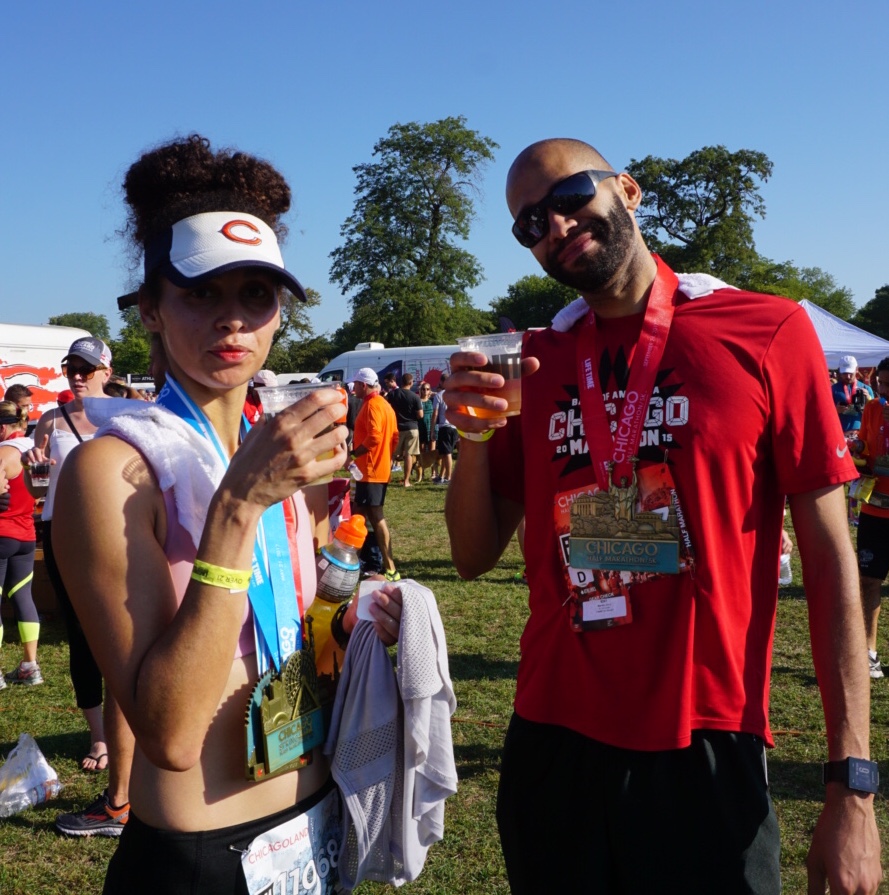
 Hyde Park Hustle